
Custom vs Off-the-Shelf Food Conveyors: Which Is Right for Your Process?

When specifying a conveyor for a food production facility, one of the first decisions is whether to choose a standard, off-the-shelf conveyor or have a system designed specifically for the application.
Both approaches have advantages.
For a straightforward conveying task, a standard system may be quicker to specify, easier to purchase and more economical. However, food production environments can introduce additional challenges, from hygiene and washdown requirements to limited factory space, delicate products, and the need to integrate multiple pieces of processing equipment.
As these requirements become more complex, the decision often shifts from simply choosing a conveyor to engineering a solution for the process.
That solution might be a single modified conveyor, a bespoke transfer section, an access platform or gantry, or a complete production line designed and manufactured from the ground up.
So when does custom engineering make sense – and when is an off-the-shelf conveyor perfectly adequate?
What is an off-the-shelf food conveyor?
An off-the-shelf or standard conveyor is based around an existing range of predetermined sizes, components and configurations.
Depending on the manufacturer, there may still be options for belt width, conveyor length, height, speed, belt material and other features. However, the fundamental design is normally based upon an established product platform.

This approach can work particularly well where the requirement is straightforward.
For example, if packaged products simply need to travel several metres in a straight line between two operations, there may be little justification for designing an entirely bespoke system.
Standardisation can offer several benefits, including simpler specification, potentially shorter lead times and greater certainty over the initial equipment cost.
What is a custom food conveyor?
A custom conveyor starts from a different point.
Rather than asking "Which conveyor fits this application?", the design process asks "What does this production process need to achieve?"
The conveyor is then developed around those requirements.
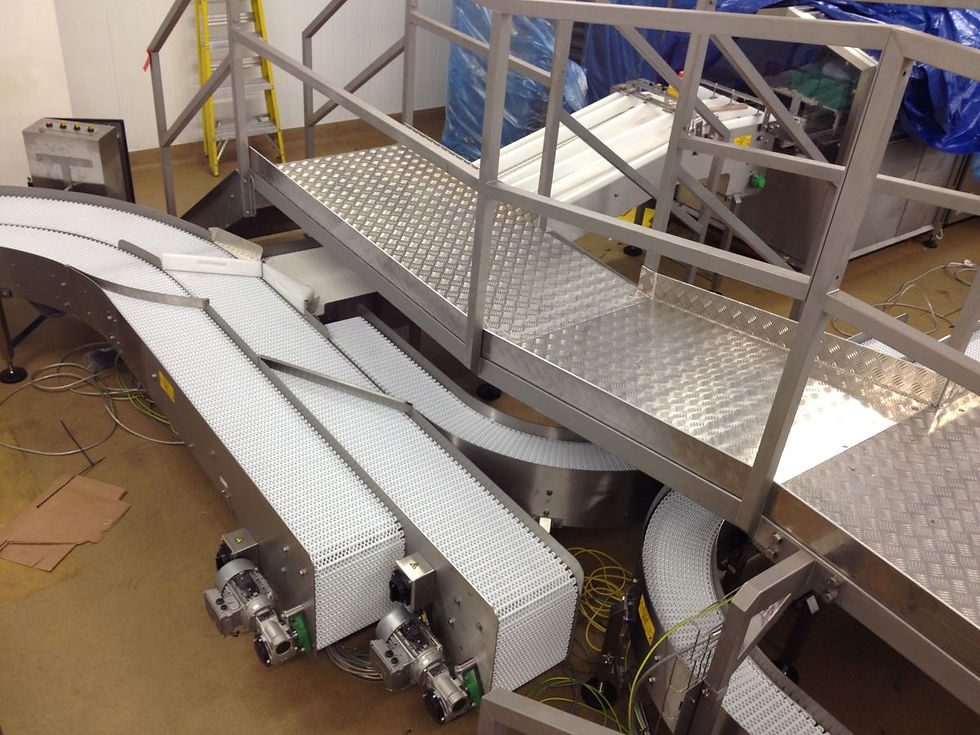
This might involve something relatively simple, such as manufacturing equipment to a particular width, height or length. It might also mean producing a special conveyor section to connect two existing machines, altering a transfer point, incorporating an incline or bend, or adding guarding, walkways, access platforms or gantries.

At the other end of the scale, a manufacturer may require a complete conveying line designed from scratch, with multiple conveyors, platforms, supports, controls, interfaces, and access systems engineered as a single coordinated solution.
In food production, the design may also need to consider hygiene, washdown, product characteristics, drainage, operator access and cleaning procedures.
The main difference is therefore not simply whether a conveyor is available in a standard size.
It is the level of consultation and engineering that takes place before anything is manufactured.
Custom does not always mean a completely new line
There is an important middle ground between standard equipment and a fully bespoke production line.
Many manufacturers already have equipment that works perfectly well but need one area adapted.
For example, they may need:
A special conveyor section between two existing machines
A change in conveyor height or direction
An improved product transfer
A replacement section within an existing line
An incline or decline
A bespoke chute or discharge arrangement
Additional guarding
A walkway or maintenance platform
A gantry across or above equipment
New supports or structural steelwork
Access stairs or handrails
A conveyor modified to accommodate new machinery
In these situations, replacing an entire line may be unnecessary.
A custom food conveyor manufacturer can instead engineer the missing piece around the equipment already in place.
This can be particularly valuable in established food factories, where production lines often evolve over many years and new machinery must be integrated alongside existing assets.
When does a complete custom conveyor line make sense?
There are also situations where starting with individual standard conveyors can create unnecessary compromise.
A new production line may need several machines to operate together at different speeds and heights. There may be requirements for accumulation, inspection, weighing, processing, packing, operator access and cleaning.

In these circumstances, it can make more sense to consider the whole line as a single engineering project.
A complete bespoke conveyor system might include:
Product infeed conveyors
Incline or decline conveyors
Transfer conveyors
Inspection sections
Distribution conveyors
Accumulation areas
Platforms and walkways
Gantries
Stairs and access systems
Guarding
Chutes and transition sections
Interfaces with processing machinery
Interfaces with weighing and packaging equipment
Control systems
Structural supports
Designing these elements together can help ensure that heights, speeds, access requirements, transfers and supporting structures work as one coordinated system.
This can be especially important in a new production area, a factory expansion, or a complete process redesign.
What does a consultative approach to conveyor design involve?
A fully consultative approach begins with understanding the process rather than immediately specifying equipment.
This might involve questions such as:
What product is being transported?
What throughput is required?
What happens immediately before and after the conveyor?
Is the product packaged or exposed?
How delicate is the product?
What cleaning regime is required?
How much space is available?
Are there columns, drains, pipework or other obstacles?
How will operators interact with the equipment?
How will maintenance teams gain access?
Are platforms, walkways or elevated access required?
Does the system need to connect several machines?
Could production requirements change in the future?
For more complex projects, this is often supported by a site survey and adetailed CAD design.

This process can reveal that the conveyor itself is only part of the problem.
A bottleneck might be caused by poor transfer between machines, insufficient accumulation, an awkward product drop, restricted operator access, or a mismatch between the speeds of different pieces of equipment.
A consultative approach, therefore, looks at product flow, access, and integration as a whole rather than treating each conveyor as an isolated component.
When is an off-the-shelf food conveyor the better choice?
Not every conveying application needs custom engineering.
If the requirement is simple, the operating environment is relatively straightforward and suitable standard equipment is readily available, an off-the-shelf conveyor can be the logical choice.
Typical examples might include applications where:
Product simply needs to move between two clearly defined points
There is plenty of available space
Standard dimensions are suitable
There are no difficult transfers
Hygiene requirements can be met by the standard design
There is little interaction with surrounding machinery
No special platforms, supports or access systems are required
Production requirements are unlikely to change significantly
In these situations, additional design and manufacturing work may add cost without delivering a meaningful operational benefit.
This is an important part of specifying equipment correctly: customisation should solve a problem, not simply add complexity.
When does a custom conveyor make more sense?
The case for custom engineering becomes stronger as the number of process constraints increases.
Imagine, for example, that a conveyor needs to receive unpackaged food from one machine, pass around an existing structural column, rise to a different working height and accurately deliver the product into a multihead weigher.

At the same time, it must provide operator access, be suitable for washdown and fit within a production area where every square metre of floor space matters.
It may be possible to achieve this using several standard conveyors and additional modifications.
However, it may be more effective to design the complete conveying arrangement around the factory and process from the outset.
Custom conveyor design can therefore be particularly useful for:
Existing factories with restricted space
Retrofit projects
New production lines
Factory expansions
Complex conveying layouts
Unusual conveyor routes
Multiple equipment interfaces
High-care or hygienic applications
Difficult or delicate products
Specific transfer requirements
Unusual infeed or discharge heights
Processes requiring operator interaction
Lines requiring platforms or gantries
Production areas requiring bespoke supporting steelwork
Lines handling several product formats
The question is not whether the conveyor can be customised. It is a question of whether doing so provides a worthwhile improvement.
Does custom mean everything has to be manufactured from scratch?
No.
A bespoke conveyor system does not necessarily mean designing every component from a blank sheet of paper.
Good custom engineering will normally combine proven standard components with purpose-designed fabricated elements.
Motors, bearings, belts, controls and many other components may be established products. Frames, supports, guarding, transfers, brackets, platforms and layouts can then be engineered around the specific application.
This approach can provide the benefits of customisation without introducing unnecessary complexity.
In fact, one of the objectives of good bespoke design should be to use standard, maintainable components wherever they are appropriate.
Why does in-house manufacturing matter for bespoke conveyor systems?
Custom conveyor manufacturing often involves far more than simply assembling conveyor components.
A system may require stainless steel frames, brackets, supports, platforms, guards, chutes, gantries, walkways and interfaces with other equipment. These components may need to be laser-cut, formed, bent, welded, deburred, finished, and assembled.
If much of this work is subcontracted, several companies may be involved in producing a single conveyor system.
An alternative is a more vertically integrated manufacturing approach in which design, metal engineering, fabrication, welding, and assembly take place within the same manufacturing environment.
Wrightfield, for example, combines conveyor design and manufacturing with an on-site metal engineering facility that provides capabilities including laser cutting, bending, forming, deburring, and metal flattening, alongside qualified welding and assembly teams.
From a customer's perspective, the important point is not simply whether these processes are in-house. The potential benefit is the ability for design and manufacturing teams to work closely together when a bespoke component, modification or engineering solution is required.

This becomes even more relevant on complete line projects, where conveyors, supports, walkways, platforms, guarding and structural elements may all need to be designed to work together.
It can also be particularly useful on retrofit projects, where relatively small dimensional or design changes can make the difference between equipment fitting naturally into an existing line and requiring additional modifications during installation.
Is a custom conveyor more expensive than an off-the-shelf conveyor?
Initially, it can be.
Engineering, site surveys, CAD design and bespoke manufacturing all have costs associated with them. If a standard conveyor already performs the required task, paying for additional engineering may make little financial sense.
However, initial purchase price is only one part of the calculation.
Consider two hypothetical solutions.
Option A: A standard conveyor costs less initially but requires additional supporting steelwork, modifications to an existing machine and changes to the surrounding layout.
Option B: A custom conveyor costs more initially but is designed to connect directly with the existing equipment and fit the available space.
The cheapest conveyor may therefore not produce the cheapest completed installation.
The same principle applies to complete lines. Purchasing several individual standard conveyors may appear economical, but additional engineering may be required to connect them, create access platforms, support elevated sections, or resolve unsuitable transfer points.
Other factors worth considering include:
Installation costs
Production downtime
Additional fabrication
Supporting structures
Platforms and access
Cleaning time
Maintenance access
Product losses
Labour requirements
Energy consumption
Spare parts
Future modifications
For this reason, comparing total cost of ownership and total installed cost can be more useful than comparing purchase prices alone.
Can custom conveyors make better use of factory space?
This is one area where bespoke design can offer a clear advantage.
Food factories are rarely empty rectangular rooms waiting for a new production line.
There may already be processing equipment, walkways, drainage, columns, services, electrical panels, pipework and structural supports occupying the available space.
Standard conveyors have fixed dimensional constraints. Bespoke equipment can instead be designed around these restrictions.
This might involve changing conveyor widths, introducing bends or inclines, altering support arrangements, elevating a section above another process or designing transfers that reduce the overall footprint.
Walkways and gantries can also form part of the solution where operators or maintenance teams need safe access around or above equipment.
For new factories, standard equipment may be accommodated during the initial layout.
For established factories, the opposite is often true: the equipment has to accommodate the building.
What about hygiene and cleaning?
Hygiene should be considered regardless of whether a conveyor is standard or bespoke.
Many standard food conveyors are specifically designed for hygienic environments and can be entirely suitable for their intended applications.
The advantage of bespoke engineering appears where the cleaning requirement is more specific.
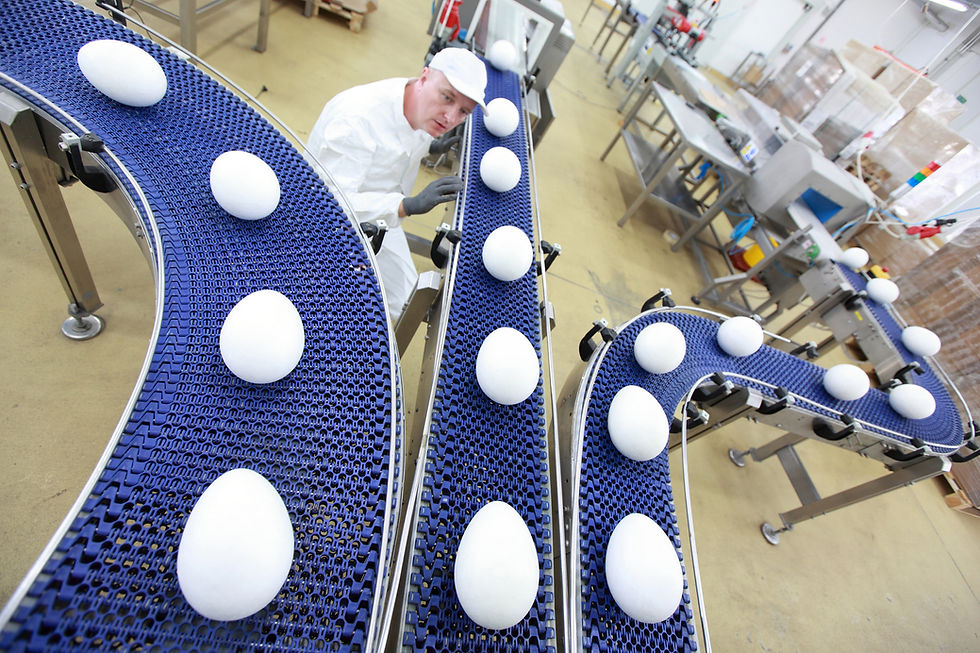
For example, the design might need to provide additional access beneath a belt, accommodate particular washdown procedures, avoid potential collection points or allow components to be removed quickly for cleaning.
Platforms and structures around the conveyor should also be designed so they do not unnecessarily obstruct cleaning access or create areas where debris or water can collect.
The product itself is also important.
A conveyor transporting sealed cartons has very different hygiene requirements from one carrying exposed salad leaves, raw meat, bakery ingredients or wet vegetables.
The appropriate question is therefore not "Is a bespoke conveyor more hygienic?"
It is:
"Does the complete conveyor system meet the hygiene requirements of this particular product and production environment?"
How important are transfers between conveyors and other equipment?
Very.
A conveyor can perform perfectly in isolation and still cause production problems if the transfer at either end is poorly designed.
Product may need to move from a slicer onto a conveyor, from one conveyor to another or from a conveyor into a weighing or packaging system.
The designer may need to consider belt gaps, drop heights, relative speeds, product orientation, guides, and the product's physical characteristics.
For robust packaged products, these factors may be relatively easy to manage.
For delicate, sticky, wet, loose or irregular food products, transfer design can become a major part of the engineering challenge.
This is another situation where considering the complete process rather than an individual conveyor can be beneficial.
On a full-line project, designing all transfer points together can help avoid problems that sometimes arise when several independently supplied conveyors are connected later.
What if the production line needs to change in the future?
Future requirements are worth discussing, regardless of which type of conveyor is selected.
If production volumes, products and factory layouts are unlikely to change, a simple standard system may be entirely appropriate.
Where expansion or changes are anticipated, greater flexibility may be valuable.
A manufacturer might expect to introduce different pack sizes, increase throughput, replace a processing machine or add another production stage.
On a completely bespoke line, future expansion might influence the positioning of conveyors, the capacity of structures, the arrangement of platforms or the ability to add another conveyor or process later.
It is not always practical or economical to design equipment for every possible future scenario. However, identifying likely changes during the specification stage can prevent today's conveyor from unnecessarily restricting tomorrow's production line.
Standard or bespoke: what questions should you ask?
Before deciding, it can help to work through a few basic questions:
"Can a standard conveyor perform the required task without significant compromise?"
If yes, there may be little reason to specify bespoke equipment.
"Will surrounding machinery or the factory need to be modified to accommodate it?"
If substantial changes are required, a custom design may deserve closer consideration.
"Do you need one conveyor or a complete integrated line?"
Where several conveyors, machines, platforms and access systems need to work together, looking at the complete process can be more effective than specifying each item separately.

"Are product transfers straightforward?"
Difficult products or transfers can increase the value of application-specific engineering.
"How important are hygiene and cleaning access?"
The selected equipment should suit the actual food environment rather than simply carrying a generic "food grade" description.
"Is space restricted?"
Custom engineering can become increasingly valuable where equipment needs to fit around existing factory constraints.
"Are walkways, platforms or gantries required?"
These should ideally be considered alongside the conveying system rather than added as an afterthought.
"Could the process change?"
Consider whether today's solution provides reasonable flexibility for foreseeable production requirements.
"What is the completed cost rather than simply the conveyor price?"
Installation, supporting steelwork, modifications, downtime, maintenance, and cleaning should all be included in the comparison.
So, is custom or off-the-shelf better?
Neither approach is automatically better.
For straightforward applications, standard conveyors can provide a simple, proven and cost-effective solution. There is little value in adding bespoke engineering where it does not solve a genuine problem.
As production requirements become more complex, however, the value of a consultative approach increases.
That may mean modifying one part of an existing system, manufacturing a special conveyor section, adding a walkway or gantry, integrating new machinery or designing an entire conveying line from scratch.
Restricted space, existing machinery, unusual products, hygiene requirements, difficult transfers, operator access and future expansion can all make it worthwhile to design the conveyor around the process rather than select the closest available standard configuration.
Perhaps the simplest way to approach the decision is this:
If the process can comfortably accommodate a standard conveyor, standard equipment may be the sensible choice. If the process would need to be changed or compromised to accommodate the conveyor, it may be time to consider a custom solution.
And where several conveyors, machines and supporting structures need to operate together, it may be more appropriate to stop thinking in terms of individual conveyors altogether and instead consider the complete production line as one integrated engineering system.
The objective in every case should be the same: to select the simplest, most reliable and maintainable solution that meets the needs of the production process.


Comments