
Custom Conveyor Systems: A Practical Guide to Bespoke Conveyors for Food Manufacturing

Choosing a conveyor system for a food production environment is rarely as simple as selecting a belt width, length and speed.

Every factory is different. Available space, product characteristics, hygiene requirements, existing machinery, production rates, operator access and future plans can all influence the type of conveyor required.
For straightforward applications, a standard conveyor may provide the simplest and most economical solution. However, where a conveyor needs to integrate with existing equipment, negotiate restricted spaces or perform a specific production function, a custom conveyor system can offer significant advantages.
This guide looks at the questions manufacturers should consider when deciding between standard and bespoke conveyor systems.
What is a custom conveyor system?
A custom conveyor system is designed around the requirements of a particular production process rather than being selected from a predetermined range of standard conveyor sizes and configurations.
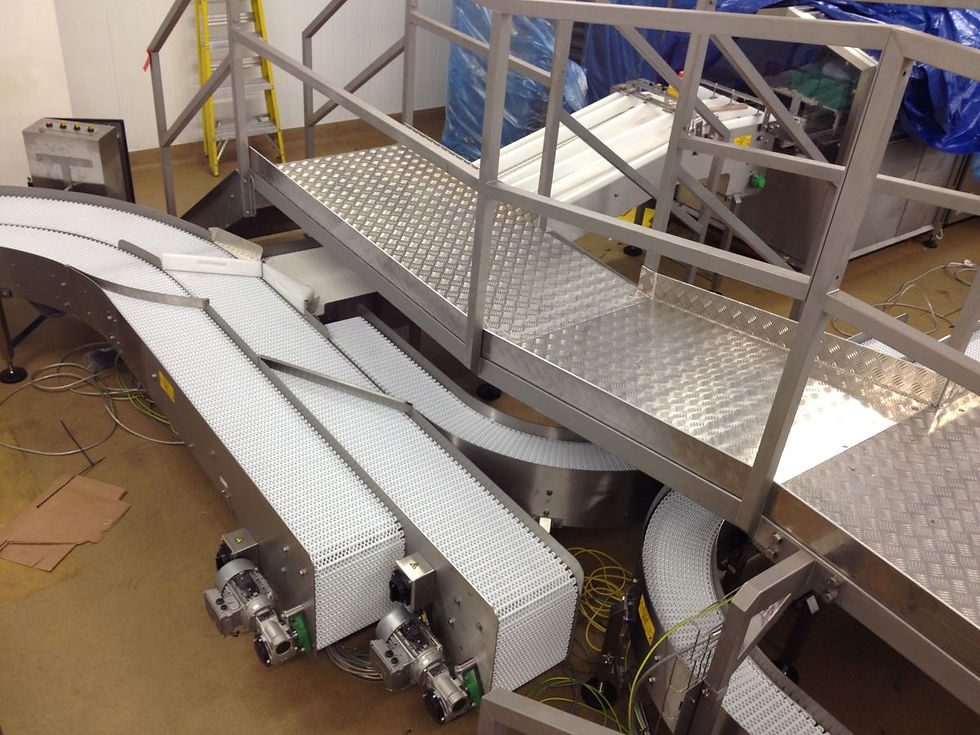
This can involve relatively simple modifications, such as changing conveyor dimensions, belt type or discharge height, through to complete conveying systems incorporating multiple conveyors, bends, inclines, transfers, platforms, guarding, controls and interfaces with processing or packaging equipment.
In food manufacturing, bespoke conveyors can also be designed around hygiene, washdown, product handling and food safety requirements.
The important distinction is that the conveyor is designed around the process rather than requiring the process to be adapted around the conveyor.
When should you consider a bespoke conveyor rather than an off-the-shelf system?
A standard conveyor can be perfectly suitable when the application is straightforward and there is sufficient space to accommodate it.
Custom conveyor design becomes particularly useful when there are additional constraints.
These might include:
Restricted factory space
Unusual conveyor routes
Specific infeed or discharge heights
High-care or hygiene requirements
Delicate or difficult-to-handle products
Multiple product formats
Washdown requirements
Operator access requirements
Production bottlenecks
Future expansion plans
Unusual throughput or speed requirements
The decision should therefore be based on the overall process rather than simply comparing the purchase price of two conveyors.
What are the advantages of a custom conveyor system?
The primary advantage is flexibility.
Instead of designing the production area around predetermined conveyor dimensions, equipment can be designed to use the available space efficiently.
This can be particularly valuable in established food factories where production lines have evolved over many years and available space is limited.

Bespoke systems can also provide greater control over transfers, product orientation, conveyor speeds, accumulation and interaction with upstream and downstream machinery.
The result can be a conveyor system that becomes an integrated part of the production process rather than simply a method of transporting product from one location to another.
Are custom conveyors always better than standard conveyors?
No.
A well-selected standard conveyor can be the most sensible solution for a straightforward application.
Custom engineering adds most value where the production requirement cannot be adequately addressed by standard equipment.
A good conveyor assessment should therefore start with the process rather than with the assumption that bespoke equipment is automatically required.
In some cases, the most appropriate solution may actually combine standard equipment with custom-built conveyors, transfers, supports or interfaces.
Are bespoke conveyor systems more expensive?
The initial purchase price of a custom food conveyor may be higher than that of a comparable standard conveyor. However, purchase price does not necessarily represent the total cost of the installation.
Manufacturers should also consider:
Installation requirements
Production downtime
Additional supporting structures
Modifications to surrounding machinery
Labour requirements
Cleaning time
Maintenance access
Product damage or waste
Future modifications
Potential production bottlenecks
A cheaper conveyor that requires extensive modification elsewhere in the factory can ultimately become the more expensive solution.
This is why total cost of ownership is generally more useful than purchase price alone when comparing conveyor systems.
How are custom conveyors designed for an existing food factory?
The process normally begins with understanding what needs to happen to the product.
This includes where the product originates, where it needs to go, how quickly it must move and what happens immediately before and after the conveyor.

A site survey can then establish physical constraints such as floor space, columns, drainage, access routes, existing machinery and available working heights.
Modern conveyor design will typically use CAD systems to develop the proposed layout before manufacturing begins.
This allows potential clashes, access problems and integration issues to be identified before equipment reaches the factory floor.
Why is equipment integration important?
A conveyor rarely operates completely independently.
It may feed or receive product from equipment such as:
Multihead weighers
Slicers
Depositors
Washers
Dryers
Metal detectors
Checkweighers
Packaging machinery
Processing equipment
Inspection systems
Each machine can have different infeed heights, discharge arrangements, operating speeds and control requirements.

Designing the conveyor around these interfaces can help create a smoother production flow and reduce the need for modifications during installation.
Can custom conveyors help solve production bottlenecks?
Potentially, but the bottleneck needs to be correctly identified first.
Increasing conveyor speed does not automatically increase production capacity.
The restriction may instead occur at a transfer point, processing machine, weighing system, packing operation or accumulation area.
Understanding product flow across the complete line allows conveyor capacity, belt speed, accumulation and transfers to be considered together.
In some applications, relatively small changes to conveyor layout can have a significant effect on overall production efficiency.
Why are product transfers important in conveyor design?
Transfers are one of the most important areas of any conveyor system.
Products moving between conveyors or between conveyors and processing machinery can become damaged, misaligned or trapped if the transition is poorly designed.
This becomes particularly important when handling delicate, irregular or unpackaged food products.
Transfer design may consider:
Product dimensions
Product orientation
Drop height
Belt gaps
Relative conveyor speeds
Product stability
Transfer plates
Nose rollers
Side guides
Reducing unnecessary drops and abrupt changes in direction can improve product handling and reduce waste.
How important is hygiene when designing food conveyors?
Hygiene should influence the conveyor from the beginning of the design process rather than being considered afterwards.

Food conveyor design may need to consider:
Stainless steel construction
Hygienic welds
Open-frame designs
Drainage
Accessible cleaning areas
Appropriate belt materials
Reduced dirt traps
Washdown requirements
Removal of belts or components for cleaning
The precise requirements will depend upon the product and production environment.
A conveyor carrying packaged products in a low-risk area will have very different requirements from equipment handling exposed food in a high-care environment.
Can a bespoke conveyor be easier to clean?
Yes, if hygiene and cleaning access are incorporated into the original design.
Conveyors can be designed to provide access to belts, rollers, frames and product contact areas.
Features such as open frameworks, accessible components, suitable drainage and appropriate materials can help cleaning teams carry out their work more effectively.
However, custom manufacture does not automatically make equipment hygienic. Hygienic design principles still need to be applied throughout the engineering process.
Why does the manufacturing process matter when buying a custom conveyor?
Bespoke equipment often requires considerably more than conveyor assembly.
Frames, brackets, supports, guards, platforms and other components may require cutting, bending, forming, welding, deburring, finishing and assembly.
Where these operations are coordinated within one manufacturing environment, design and production teams can work more closely together when changes or engineering challenges arise.
For example, Wrightfield's manufacturing facility incorporates conveyor design and assembly alongside metal engineering capabilities including laser cutting, bending, forming, deburring and metal flattening, together with qualified welding capabilities.

The advantage of this type of manufacturing structure is not simply convenience. It can reduce the number of separate suppliers involved in producing a system and provide greater control over manufacturing quality, tolerances, modifications and production scheduling.
Does in-house manufacturing make customisation easier?
It can.
Bespoke manufacturing frequently involves components that do not exist as standard catalogue items.
A mounting bracket may need a different profile. A support may have to avoid existing pipework. Guarding might need altering to provide operator access. A conveyor frame may require modification following a site survey.
Having access to fabrication and metalworking capabilities can make these relatively small but important changes easier to incorporate into the overall design.
This becomes particularly useful when producing equipment for existing factories, where unexpected constraints are common.
What information does a conveyor manufacturer need?
Providing detailed information early in a project can considerably improve the design process.
Useful information includes:
Product type
Product dimensions and weight
Required throughput
Existing conveyor speeds
Available floor space
Infeed and discharge heights
Existing equipment details
Hygiene requirements
Cleaning procedures
Electrical and control requirements
Operator access requirements
Factory drawings
Photographs or video of the production area
Future production plans
A site survey may also be appropriate for more complicated installations.
Can a custom conveyor fit into an existing production line?
Yes. In fact, this is one of the most common reasons for choosing bespoke equipment.
Factories frequently need to replace or upgrade one section of a production line without replacing everything around it.
A replacement conveyor can therefore be designed around the dimensions, speeds, heights and interfaces of existing machinery.
Accurate measurement and understanding of the surrounding process are particularly important in retrofit projects.
Can conveyor systems be designed for future expansion?
They can, although future requirements need to be discussed during the design stage.
Manufacturers may anticipate increased production volumes, additional packaging formats, new processing machinery or changes to factory layouts.
Where appropriate, conveyor layouts, controls and support structures can be designed with these possibilities in mind.
This does not necessarily mean over-engineering the original installation. It means considering whether today's design could unnecessarily restrict tomorrow's production requirements.
How do you choose the right belt for a food conveyor?
There is no single conveyor belt suitable for every food application.
Selection may depend upon:
Product type
Temperature
Moisture
Oil or fat content
Incline angle
Cleaning chemicals
Hygiene requirements
Product grip
Required drainage
Transfer requirements
Different applications may use modular plastic belts, PU belts, mesh belts or other specialist materials.
Belt selection should therefore be considered as part of the overall conveyor design rather than treated as an isolated component choice.
What should manufacturers consider when comparing conveyor quotations?
Comparing conveyor quotations purely on price can be misleading because the scope of supply may differ considerably.
Questions worth asking include:
Has the conveyor been designed specifically for the application?
Are installation and commissioning included?
What materials are being used?
How has hygiene been considered?
How accessible are components for cleaning and maintenance?
Who manufactures the fabricated components?
Are controls included?
How will the conveyor integrate with existing machinery?
What guarding and safety provisions are included?
What after-sales and spare parts support is available?
Understanding these differences makes it easier to compare proposals on a like-for-like basis.
How long does a custom conveyor system last?
There is no universal lifespan because operating conditions vary considerably.
Construction quality, operating hours, cleaning regimes, maintenance, product characteristics and the surrounding environment can all affect equipment life.

One advantage of well-engineered bespoke equipment is that individual wear components can often be serviced or replaced without replacing the entire conveyor.
Availability of spare parts and ongoing engineering support should therefore be considered when selecting equipment.
Can existing conveyors be modified rather than replaced?
Sometimes.
Before replacing equipment, it can be worth investigating whether the existing system can be altered.
Possible modifications include changes to:
Conveyor speeds
Drives
Supports
Guides
Transfer arrangements
Guarding
Controls
Infeed or discharge sections
The viability of modification depends on the age, condition and fundamental design of the existing conveyor.
If substantial changes are required, replacement may provide better long-term value.
What makes a good custom conveyor design?
A good conveyor is not necessarily the most complicated one.
The best solution is generally the simplest design that reliably achieves the required process.
Good conveyor design should balance:
Product handling – moving the product without unnecessary damage or disruption.
Hygiene – enabling effective cleaning appropriate to the food environment.
Accessibility – allowing operators and maintenance teams to reach necessary components.
Reliability – avoiding unnecessary complexity and points of failure.
Integration – working effectively with upstream and downstream equipment.
Safety – considering guarding, access and interaction with operators.
Maintainability – making wear components accessible and replaceable.
Flexibility – accommodating different products or future production requirements where necessary.
What questions should you ask before specifying a custom conveyor?
Before approaching a conveyor manufacturer, it is useful to answer a few fundamental questions:
What product needs to be moved?
Where is it travelling from and to?
What throughput is required?
What equipment sits before and after the conveyor?
How much space is available?
What hygiene standard is required?
How will the conveyor be cleaned?
Who needs access to it?
Are there existing production problems that need solving?
Could the production requirement change in the future?
These questions help shift the discussion away from simply “What conveyor do we need?” towards the more useful question:
“What does our production process need the conveyor to achieve?”
Custom vs standard conveyors: which should you choose?
There is no universal answer.
For a simple movement task with few constraints, an off-the-shelf conveyor may provide everything required at a competitive cost.

As the number of constraints increases, the argument for bespoke design becomes stronger.
Restricted space, unusual products, hygiene requirements, multiple equipment interfaces, difficult transfers and existing factory layouts can all make custom engineering worthwhile.
The objective should not be to specify a bespoke conveyor simply because it can be built.
It should be to determine whether a custom solution can deliver measurable improvements in product flow, hygiene, reliability, accessibility, integration or long-term operating cost.
Ultimately, the most effective conveyor is not necessarily the most sophisticated or the most expensive.
It is the one designed around what the production process actually needs.


Comments